If you've been tracking the Denver metro housing market from the sidelines this summer, June's numbers are worth a real look — not because anything dramatic happened, but because of what didn't. Prices held. Days on market barely moved. And behind the scenes, a lot more sellers are sweetening deals than the headlines let on. Here's what the data actually says, and what it means whether you're buying in Jefferson County's foothills or listing a place in Littleton.
The June Numbers, Plain and Simple
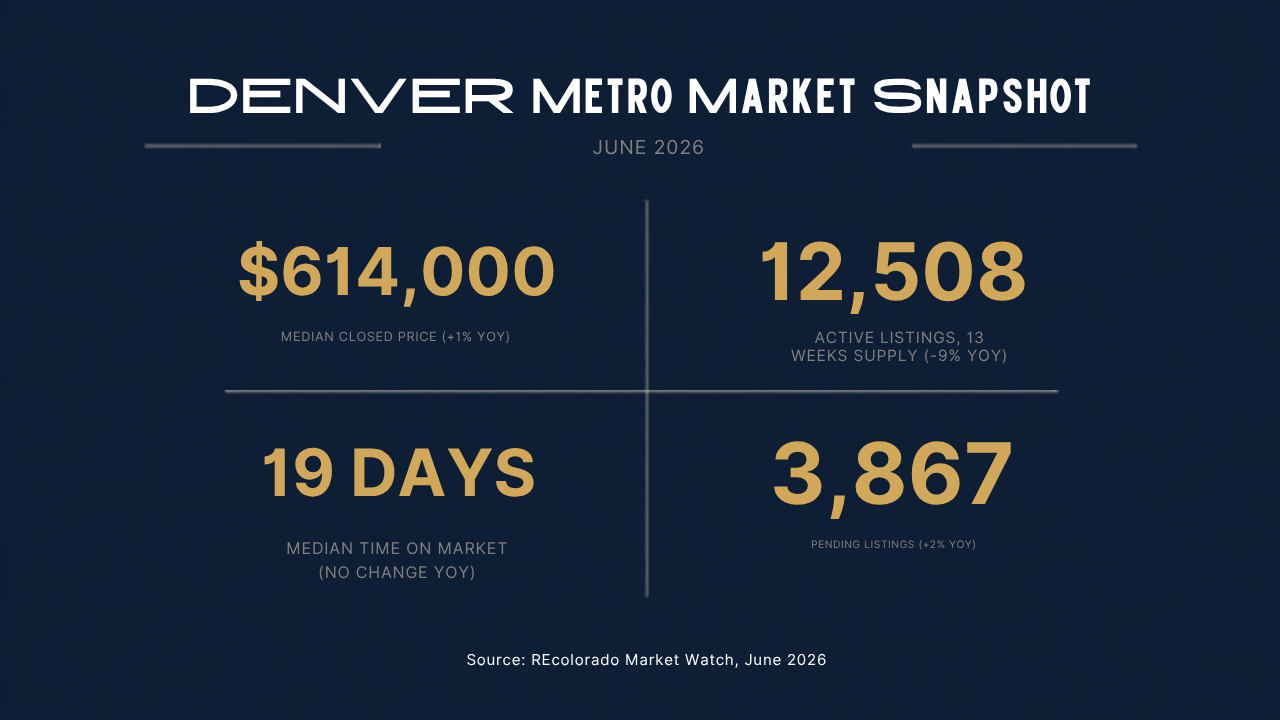
According to REcolorado's Market Watch report, the median closed price across the Denver metro landed at $614,000 in June — up just 1% from a year ago and unchanged from May. Homes spent a median of 19 days on the market, identical to June 2025, though that's three days longer than May, a normal seasonal shift as spring's urgency fades into summer.
A few more numbers worth knowing:
New listings: 5,754, down 3% year over year and 4% from May
Pending listings: 3,867, up 2% year over year (though down 3% from May, a typical seasonal cooldown)
Active inventory: 12,508 listings, down 9% from last year — about 13 weeks of supply
Closed sales: 4,024, essentially flat year over year, down 1% from May
Gross sales volume: up 1% year over year, another sign of a market holding steady rather than swinging
Taken together, this is a market that's normalizing after the spring rush, not one that's losing steam. Fewer new listings and fewer closings, but pending activity still ticking up year over year, tells us buyers haven't checked out — they're just moving at a more deliberate pace.
That 13 weeks of supply figure is worth sitting with for a second. It's down from last year, but it's still enough inventory that this isn't a market where buyers feel forced into rushed decisions. Historically, anything under about 12 weeks starts to tilt toward sellers, while 20 weeks or more starts to favor buyers — so June's Denver metro sits close to the middle, which tracks with everything else in this report: steady, not tilted hard in either direction.
What This Means If You're Buying
Inventory is tighter than it was a year ago, but the extra few days homes are sitting on the market this month means there's still room to negotiate — particularly on listings that have been up for a few weeks without an offer. If you're searching Evergreen, Conifer, or Golden specifically, expect that competition to feel different than in Denver proper, where volume is higher but so is the churn. Foothills inventory tends to move in smaller batches, so a strong offer on the right property still carries real weight, even in a market that isn't desperate for buyers.
What This Means If You're Selling
Pricing accurately out of the gate matters more than ever right now. With new listings pulling back 4% from May, sellers aren't flooding the market — but that also means buyers have fewer distractions pulling them away from a well-priced, well-presented home. Homes that are priced to the current market are still moving in roughly the same window they did a year ago.
The Detail Most Headlines Miss: Seller Concessions
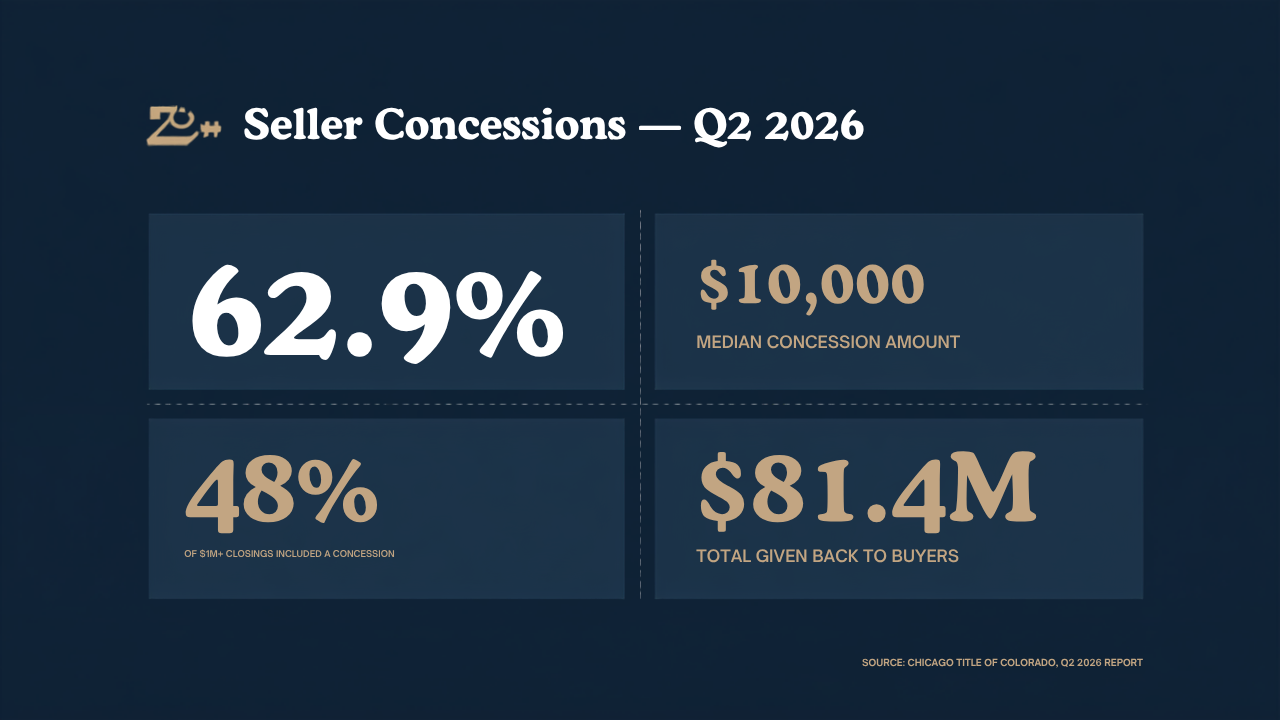
Here's a number that doesn't show up in most market recaps: how often sellers are still putting money back on the table to get a deal to the closing table. According to a Q2 2026 report from Chicago Title of Colorado, covering 12,029 closings across the six-county Denver metro between April and June, 62.9% of all closings included a seller concession — a median of $10,000 — adding up to more than $81.4 million handed back to buyers this quarter alone. Among single-family homes specifically, that figure was 63.3%.
What stands out is that concessions aren't just a starter-home story. In June, 48% of $1M+ closings in the Denver metro included a concession, averaging $15,326 — the highest average concession of any price tier tracked. And close to home, Jefferson County — the corridor running from Golden through Evergreen and Conifer — saw 63.2% of June closings include a concession, averaging $11,273.
For buyers, this is worth asking about at nearly every price point — whether toward a rate buydown, closing costs, or repairs, concessions are common enough now that they're a normal part of the conversation, not an exception. For sellers, building a concession into your pricing and negotiation strategy from the start, rather than conceding it reactively once an offer is on the table, tends to lead to a smoother path to closing.

Looking Ahead
For a broader read on where the national market is headed for the rest of the year, our colleagues at Keeping Current Matters put together a solid breakdown: What To Expect from the Housing Market in the Second Half of 2026. It's a useful companion to the local numbers above, especially if you're weighing timing on a move later this year.
A few more reads from around here that might be useful depending on where you're headed next:
Living in Littleton, Colorado: A Neighborhood-by-Neighborhood Guide
Moving to Denver? 5 Mountain Towns West of the City Worth Knowing First
What Happens When a Buyer Backs Out: A Real Morrison, CO Closing Story
Whether you're weighing a move this fall, curious what your home would sell for in today's market, or just want a second set of eyes on a concession strategy, we're happy to walk through it with you.
Let's Talk
Email us at Tim@JonesTeamColorado.com, call or text (720) 314-8462, or grab 15 minutes on our calendar: calendly.com/tim-jonesteam/15min.
Sources: REcolorado Market Watch, June 2026. Chicago Title of Colorado, Denver Metro Seller Concessions Q2 2026 Report.