If you've been watching the Denver metro housing market and trying to figure out what it's doing, you're not alone. May 2026 data from REColorado and First American Title tells an interesting story — one of resilience, selectivity, and a market that rewards preparation.
Here's what the numbers say, what they mean, and what buyers and sellers in the Denver foothills and west suburbs should do with that information.
The Big Picture: May 2026 Denver Metro Stats
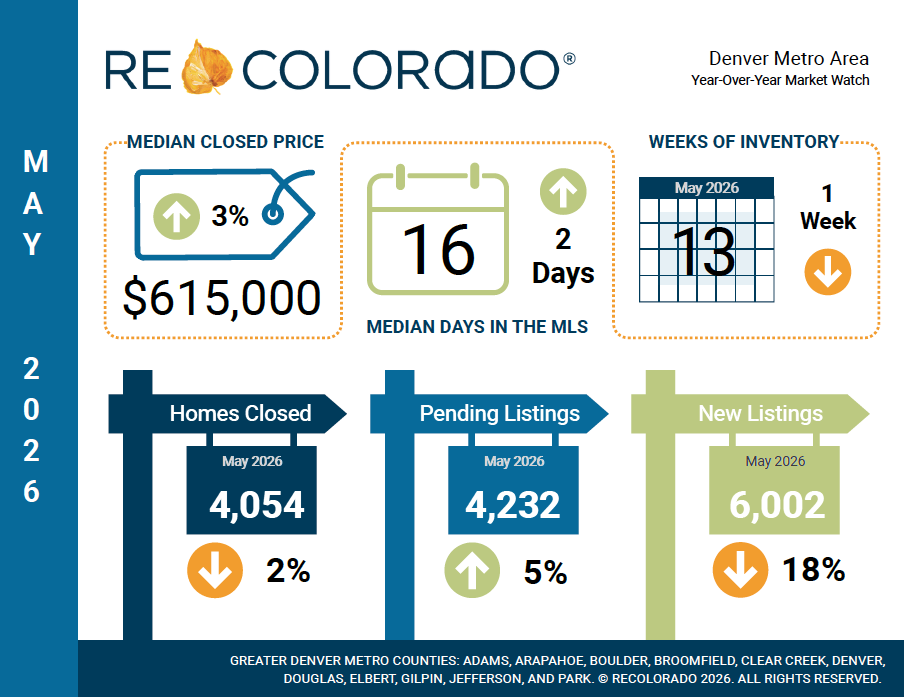
According to REColorado's May 2026 Denver Metro Market Watch, covering Adams, Arapahoe, Boulder, Broomfield, Clear Creek, Denver, Douglas, Elbert, Gilpin, Jefferson, and Park counties:
Median Closed Price: $615,000 — up 3% year over year
Homes Closed: 4,054 — down 2% year over year
Pending Listings: 4,232 — up 5% year over year
New Listings: 6,002 — down 18% year over year
Median Days in MLS: 16 days — up 2 days year over year
Weeks of Inventory: 13 weeks — indicating a balanced market
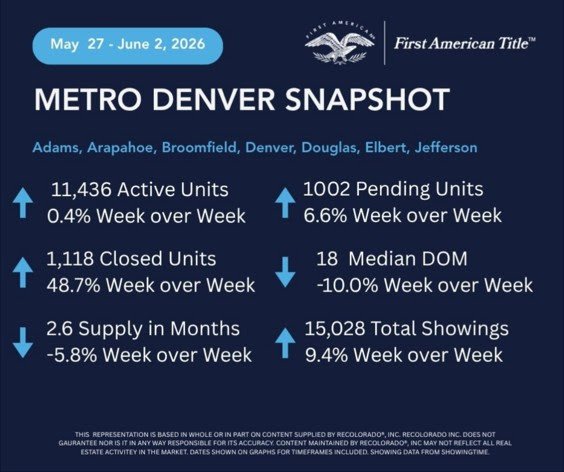
First American Title's weekly snapshot for the seven-county metro (Adams, Arapahoe, Broomfield, Denver, Douglas, Elbert, and Jefferson) for the week of May 27–June 2 showed:
11,436 active units — up 0.4% week over week
1,002 pending units — up 6.6% week over week
1,118 closed units — up 48.7% week over week (post-Memorial Day bounce)
18 median days on market — down 10% week over week
2.6 months of supply — down 5.8% week over week
15,028 total showings — up 9.4% week over week
The Memorial Day weekend slowdown was real. The bounce back was equally real. That's the Denver market in 2026.
Prices Are Holding. Here's Why.
The median closed price hit $615,000 in May — a 3% increase from a year ago. Fewer homes sold, but the ones that did held value. That's not a contradiction; it's supply and demand doing exactly what economics textbooks say it should.
New listings dropped 18% year over year. When supply tightens and qualified buyers are still active, prices don't collapse — they stabilize or edge upward. That's what you're seeing here.
Month over month, prices also rose 3%, which tells you May wasn't a fluke. Spring momentum carried through, and sellers with well-prepared, correctly priced homes benefited.
Buyers Are Active. They're Just Being Pickier.
Here's the honest truth about today's buyer: they haven't gone anywhere. Pending sales were up 5% year over year and 4% month over month. Showings are up. People are walking through homes and writing contracts.
But they are not the same buyers we saw in 2021 and 2022. Today's buyer has options, has time to think, and has a very clear checklist. Megan Aller at First American Title put it well — buyers want the best home at the best price with the best condition, updated mechanicals, a clean inspection, seller concessions, and enough equity to feel like a smart move.
If a home checks every box, it moves fast. If it misses one, buyers keep scrolling.
That's not pessimism. That's just what a more balanced market looks like after years of sellers holding all the cards.
What This Means for Sellers in the Foothills and West Metro
If you're thinking about selling a home in Evergreen, Morrison, Conifer, Pine, Golden, Bailey, Littleton, Lakewood, or Arvada — the advice is straightforward.
Price it right from day one. Buyers are doing their homework. An overpriced home doesn't negotiate down gracefully anymore — it sits, collects days on market, and trains buyers to assume something is wrong with it. The data supports pricing aggressively to attract competition, not padding the number hoping someone falls in love.
Presentation matters more than it used to. Buyers who are being selective will move on from a home that needs work — unless the price reflects it. If you're selling as-is, price it that way. If you want top dollar, prepare the home as if your buyer has options. They do.
Marketing reach is the differentiator. With 13 weeks of inventory and buyers having genuine choices, your home has to get in front of the right buyer at the right moment. That means professional photography, video, targeted digital marketing, and exposure to relocation buyers who are shopping from out of state. That's what we do.
What This Means for Buyers
This is the most buyer-friendly market we've seen in several years. You have inventory. You have time to evaluate. You are not getting pushed into a bad decision by artificial urgency.
That said, well-priced homes in good condition are still going under contract quickly. The median is 16 days on market metro-wide — but the best homes aren't sitting around waiting for you to finish deliberating. If you find a home that checks your boxes, be ready to move.
Get pre-approved before you start touring. Know your priorities. And work with an agent who will tell you the truth about a property's value and condition — not just what you want to hear.
The Bottom Line for June 2026
The Denver metro housing market is not crashing. It's not flying. It's functioning — and that's actually a good thing for buyers and sellers who come in prepared.
Prices are up modestly year over year. Supply is constrained. Demand is real, if more selective. And the post-Memorial Day data shows that buyers are back in motion heading into summer.
If you're sitting on the fence about whether now is the right time to buy or sell in the Denver foothills or west suburbs, the honest answer is: it depends on your situation. That's a conversation worth having with someone who knows this market.
Let's Talk About Your Specific Situation
Tim and Sandy Jones have been helping buyers and sellers navigate Colorado real estate since 2011. We know the foothills. We know the numbers. And we're not going to blow smoke at you about the market just to get a listing or close a deal.
If you want a straight answer about what your home is worth — or whether now makes sense for you to buy — reach out.
📱 (720) 314-8462 — call or text
Market data sourced from REColorado May 2026 Denver Metro Market Watch and First American Title Metro Denver Snapshot (May 27–June 2, 2026). Data covers greater Denver metro counties. Statistics represent aggregated metro-level trends and may vary by submarket, price point, and property type.