You know the feeling. The house is bigger than it needs to be. The stairs feel steeper than they did ten years ago. Your Saturdays belong to the gutters, the driveway, the snow, and a list that never ends. And every time downsizing in Colorado comes up, the same thought arrives first: but my rate is 3%.

If you own in Evergreen, Littleton, Conifer, Pine, Morrison or Golden and you locked in your loan in 2020 or 2021, that reaction is not silly. It is the reason we hear most often for staying put. Giving up 3% to take on 7.5% feels like being penalized for doing the right thing. We understand that.
Why the 3% feels untouchable
The feeling has numbers behind it. According to FHFA data, roughly half of all outstanding mortgages are still below 4%. Zillow estimates that trading a sub-4% loan for today's rates on the same median-priced home costs somewhere between $3,900 and nearly $8,000 more every year. If you plan to buy the same size house with the same size loan, that math is real, and staying put may be the right call.
Here is the part that gets missed
You do not get to keep the 3% when you sell. That loan is paid off at closing. So the real question is not whether to give up your rate. It is what to do with the equity that rate helped you build, and what kind of loan, if any, your next home needs.
Someone downsizing is rarely buying the same size loan. A much smaller mortgage, or none at all, changes the picture completely. Which brings us to the market you would be buying in.
What buyers are getting right now
First American Title's weekly Metro Denver Market Review, written by Megan Aller, has been telling a consistent story. As of September 30, Mortgage News Daily had the 30-year fixed rate at 7.50%. That is the headline. The deal underneath it looks different.
In the September 24 report, 51.5% of pending deals had a price reduction, averaging $53,973, or 7.7%, from original list price to the last asking price before going under contract.
So far in 2026, 82% of closed sales were financed. Roughly 4 out of 5 of those received a concession, averaging about $12,000.
In ZIP code 80122, around Southglenn in Littleton and Centennial, single-family concessions averaged $23,384 in August.
That same September 24 week showed 28.1% odds of selling, and it took 17.1 showings to produce one contract.
Concessions are increasingly used as credits for closing costs and rate buydowns instead of repair requests. On a typical $805,000 Metro Denver home, Megan's example showed a $12,000 credit used for a rate buydown trimming the monthly principal and interest payment from roughly $5,050 to about $4,850.
The honest part: you are also a seller
Those same numbers apply to the home you are selling. Buyers have time, choices, and leverage, and your house will be priced and negotiated in the same environment. A downsizer who wins on the purchase and gives it all back on the sale has gained nothing. Pricing your current home correctly from day one matters as much as the negotiating on the next one.
Equity is the tool
You would not be the first to lean on it. NAR's 2026 generational report found that 46% of buyers ages 71 to 79 and 39% of buyers ages 61 to 70 paid all cash. Boomers make up 42% of buyers and 55% of sellers. NAR has also reported that about 60% of all-cash repeat buyers funded the purchase with equity from a home they sold or still own. ICE puts the average tappable equity for mortgage holders at about $212,000.
Cash brings speed and certainty, and sellers sometimes reward that. Cotality found that sellers accepted an average 9% discount on cash purchases compared with financed ones in 2025, measured against an automated valuation. That is a national average, not a promise. A well-priced home may not move an inch for any buyer.
Two other routes worth a look
Assumable loans. If the home you want carries an FHA, VA, or USDA loan, you may be able to take over the seller's existing rate instead of getting a new one. Conventional loans usually cannot be assumed. The catch is the gap: you pay the difference between the price and the loan balance. On a $400,000 home with a $280,000 assumable loan, that is $120,000 in cash, which is where a downsizer with real equity has an edge. The seller's loan servicer, not your lender, controls approval, so expect a slower timeline than a standard purchase.
New construction. Builders are competing with resale homes on your monthly payment. NAHB's September survey found 66% of builders using sales incentives and 38% cutting prices, by an average of 6%. In Megan's Elizabeth example, a builder offered about $90,000 off plus a subsidized rate while a mid-$500,000s resale home got two showings in a month. Compare the total cost, not just the rate. Builder incentives may require the builder's preferred lender, and the price may already reflect the deal.
The math: what is your cash actually worth?
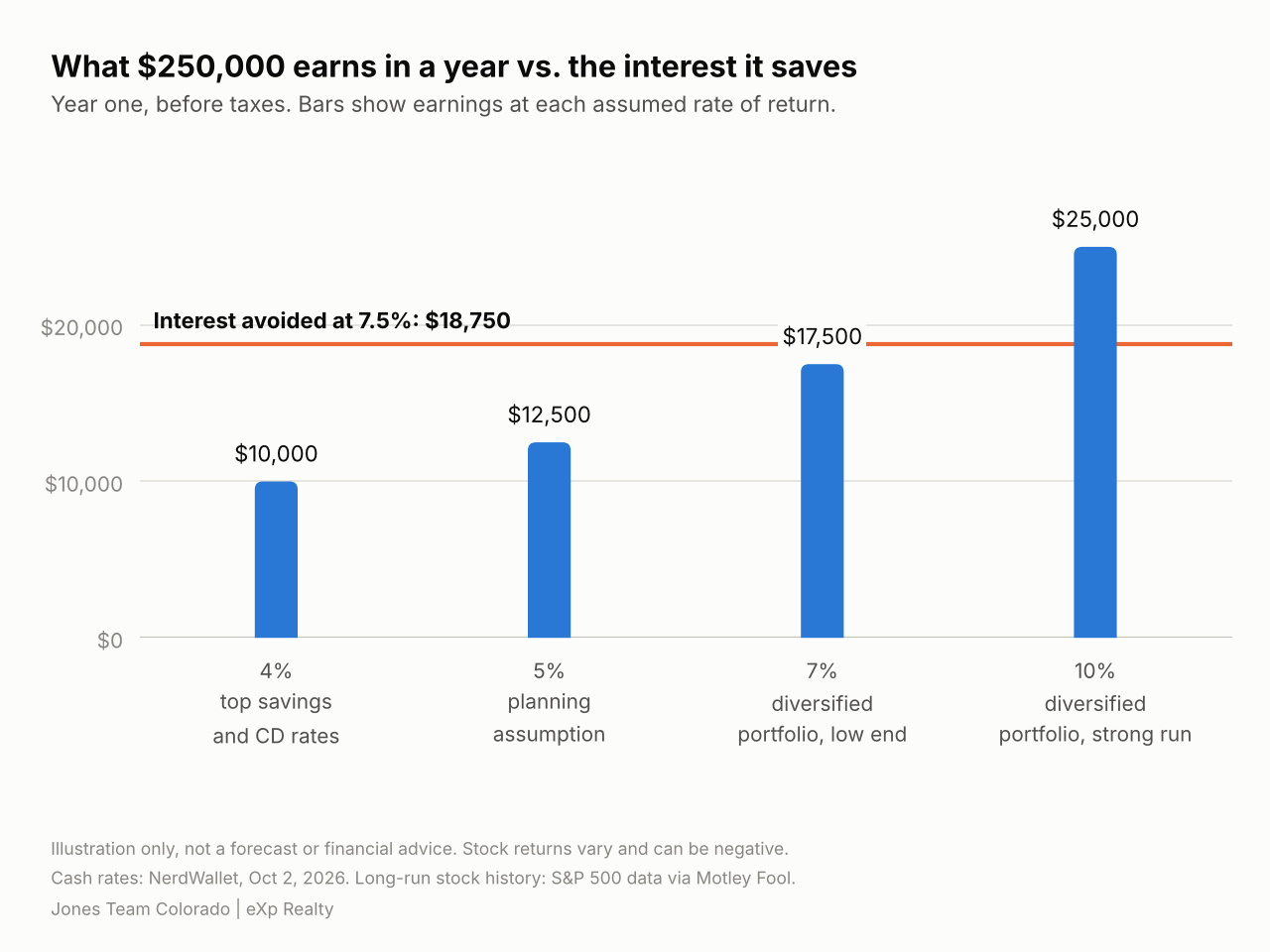
Now the logic. Say you have $250,000 of equity to put toward a purchase. You can keep it invested, or you can use it to shrink the loan. First, what does it earn if you keep it?
Top high-yield savings accounts are paying around 4%, and the best CDs run from about 4.4% for one year to 4.95% for five years (NerdWallet, October 2). Diversified stock portfolios have returned about 10% a year with dividends reinvested over the long run, roughly 6.9% after inflation, with years like 2008 when they lost 38%. A 5% planning assumption is a reasonable middle: better than cash, below the long-run stock average.
Against that, every dollar you put into the purchase avoids interest at 7.5%, or about 6.75% if a seller credit buys the rate down. On $250,000, that is $18,750 of interest avoided in year one at 7.5%.
Ten years, side by side
Take a $700,000 purchase on a 30-year loan at 7.5%. Option A: keep the $250,000 invested and carry a $560,000 loan (20% down). Option B: put the $250,000 into the purchase and carry a $310,000 loan, then invest the $1,748 a month you save on the payment. Same return on both, ten years, before taxes:
Assumed returnWho comes out ahead after 10 years4%Shrinking the loan, by about $104,0005%Shrinking the loan, by about $81,0007%Shrinking the loan, by about $28,00010%Keeping it invested, by about $73,000
Read it plainly. At 4% and 5%, using the equity to shrink the loan comes out well ahead. At 7%, it still wins by less. The break-even lands near 8%. Above that, staying invested wins, but only if the market cooperates for ten years straight, and it does not always do that.
Where this does not work
Thin equity. ATTOM reports the share of Colorado mortgaged homes that are equity-rich fell from 45.8% to 40.5% in a year. If you bought between 2021 and 2023, run your actual numbers before assuming. (We can help you with this).
No reserves. Do not put every dollar into a house. Keep a cushion you can reach.
Rate swings. If rates fall, a bigger loan can be refinanced. If they rise, as some forecasters say, a smaller loan looks better. Nobody knows which.
Taxes. The model is before taxes. Interest on savings is taxable, and mortgage interest may or may not be deductible for you.
Pricing. Cash does not fix an overpriced home.
What we would do first
Get your loan payoff and a real net-proceeds number for your current home. We can produce an ESTIMATED net-sheet for you.
Ask a lender to price three versions of the next purchase: 20% down, 50% down, and cash, plus what a seller credit buys down.
Sit down with a CPA or financial advisor and run your own numbers.
This is general information, not financial or tax advice. Rates and market figures are as of early October 2026 and will change.
Want to run your numbers?
We will walk through what your home could net, what the next purchase could look like, and whether the 3% rate is worth keeping. No pressure, just the math.
Email: Tim@JonesTeamColorado.com
Call or text: (720) 314-8462
Schedule a call: https://calendly.com/tim-jonesteam/15min
Sources: First American Title Metro Denver Market Review (Megan Aller), Sept 24 and Oct 1, 2026. NAR. ICE Mortgage Monitor. Cotality. NerdWallet. Motley Fool S&P 500 history. ATTOM via The Mortgage Point. Zillow via Stacker. FHFA lock-in data via Wolf Street.